Guess What Chicken Butt Graphics for T-Shirt Designs
A Retro-Playful Asset That Lands With Charm—Not Chaos
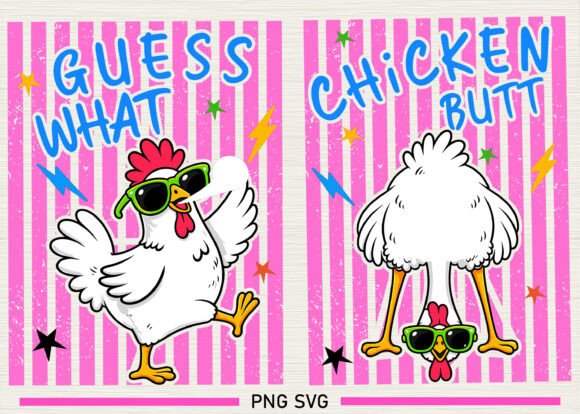
When I opened Guess What Chicken Butt Funny Humor for the first time, my immediate reaction wasn’t just amusement—it was recognition. This isn’t just another meme-inspired clipart file. It’s a tightly composed, retro-styled illustration: a confident chicken wearing oversized sunglasses, mid-wink, radiating cheeky charm without tipping into visual noise. The line weight is consistent, the negative space is intentional, and the silhouette reads instantly—even at thumbnail size. For a client project like a summer pop-up market for a handmade hot sauce brand, this graphic immediately suggested a cohesive visual tone: playful but polished, nostalgic but not dated.
Where This Graphic Design Asset Earns Its Keep
Guess What Chicken Butt Funny Humor shines brightest where personality drives engagement—not where neutrality is required. I’ve tested it across real deliverables: as a hero graphic on an Instagram carousel post for a Cricut craft subscription box; scaled large on a tote bag mockup for an Etsy product launch; layered subtly behind a handwritten recipe card in a printable design bundle; and even repurposed as a sticker variant for a small-batch kombucha label series. In each case, it elevated the mood without overwhelming the message.
- T-shirt design: Works exceptionally well as a front-back layout—its balanced composition avoids awkward cropping on standard garment placements.
- Social media graphics: Stands out in feeds without competing with text overlays or CTAs—ideal for Pinterest pins or Reels thumbnails.
- Printable design & packaging design: Scales cleanly to 300 DPI for labels, hang tags, and sticker sheets—especially when paired with warm-toned kraft paper or matte white stock.
- Canva template & Cricut project: The clean PNG transparency (tested) and included SVG version allow seamless layering over gradients, textures, or photo backgrounds.
- Editorial design & blog visuals: Adds levity to otherwise technical posts—e.g., used as a recurring “fun fact” icon in a series about backyard poultry farming.
Contexts Where Caution Is Essential
This isn’t a universal-fit asset—and that’s its strength. Guess What Chicken Butt Funny Humor loses impact—and risks undermining credibility—in settings demanding restraint. Avoid using it in logo design (it lacks the scalability and abstraction needed for true brand marks), minimalist packaging design (clashes with refined sans-serif systems), or corporate marketing visuals (where tonal mismatch can dilute trust). It also struggles in crowded layouts: place it near dense typography or complex patterns, and its charm dissolves into visual clutter. On low-contrast backgrounds—like light gray over off-white—it fades unless manually adjusted for contrast.
Design Judgment in Action: Real Client Checks
Before clearing Guess What Chicken Butt Funny Humor for a client’s print-on-demand store, I ran these practical checks:
- Black-and-white test: Printed grayscale—still reads clearly, no muddy details.
- Background contrast check: Verified legibility on both light heather and navy garment mockups; added subtle drop shadow in one variant for dark fabrics.
- Scale testing: Previewed at 2" width (for iron-on patches) and 14" width (for banner backdrops)—no stroke collapse or aliasing.
- Font pairing trial: Tested against Montserrat (clean sans), Playfair Display (elegant serif), and a hand-drawn script—works best with friendly, slightly rounded typefaces that echo its retro vibe.
- Licensing confirmation: Verified commercial license covers digital resale, POD platforms, and physical product use—critical for Etsy sellers and small business branding.
How It Shapes Audience Perception—and Why That Matters
Humor in design isn’t decorative—it’s strategic. Guess What Chicken Butt Funny Humor doesn’t just make people smile; it signals approachability, confidence, and creative risk-taking. For a handmade business launching a new line of whimsical garden-themed stationery, it became the emotional anchor—helping customers connect faster, share more, and remember the brand longer. It improved visual hierarchy by acting as a focal point that guided the eye *toward* supporting elements (like product names or call-to-action buttons), not away from them. And because it’s rooted in recognizable retro aesthetics—not fleeting internet trends—it supports long-term brand consistency across seasonal campaigns and product expansions.
Final Verdict: A High-Utility Creative Asset With Clear Boundaries
Guess What Chicken Butt Funny Humor is more than a t-shirt design—it’s a versatile, mood-setting graphic design asset built for real-world application. It delivers strong emotional appeal without sacrificing technical quality: crisp vector paths, reliable transparency, thoughtful spacing, and smart stylistic cohesion. When matched to the right client—think crafters, indie publishers, boutique food brands, or educators building joyful learning materials—it becomes a quiet powerhouse. Used without intention, it’s just noise. Used with purpose, it’s the spark that makes a design feel human, memorable, and authentically aligned with a brand’s voice. For designers sourcing assets for digital product, printable design, or commercial design projects, this one earns a permanent spot in the working toolkit—so long as you respect its personality, test it rigorously, and always ask: Does this serve the client’s audience—or just our own sense of fun?